

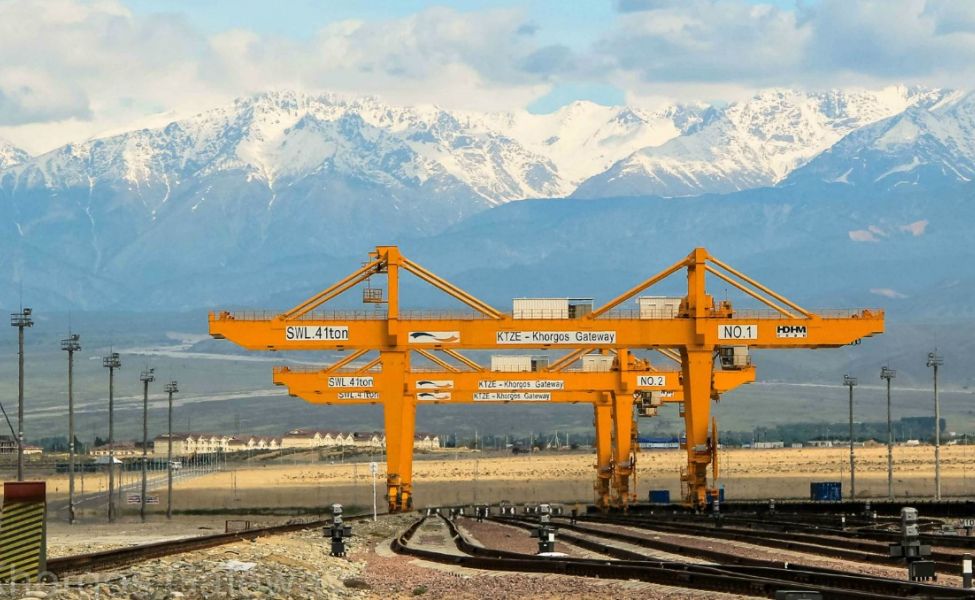
Within the BRI, Kazakhstan plays a major strategic and operative role on both rail and road logistics
A roundtable in Zürich discussed the economic implications of the Belt and Road Initiative (BRI) for Kazakhstan and Switzerland, Kazinform has learnt from the press service of the Kazakh MFA.
Mr. Alibek BAKAYEV, Kazakh Ambassador to Switzerland and Liechtenstein, and Mr. Thomas KOWITZKI, Head of Chinarail/Multimodal Service at DHL for the European Region, discussed together with representatives from media and the economy opportunities and challenges for the two countries.

DHL sees new opportunities
"Logistic is the backbone of the world economy" says Mr. Kowitzki, and the BRI will play a central role in the future. Compared to other means of transport, the BRI train line increases flexibility ("door-to-door" service, geographical coverage), reliability (clearly defined departing and arrival times, daily running trains), transparence (all customers can supervise the location of their container through GPS), and sustainability (95% less CO2 than air transport).
Within the BRI, Kazakhstan plays a major strategic and operative role on both rail and road logistics, adds Mr. Kowitzki. The Khorgos gateway at the Kazakh-Chinese boarder is the biggest dry dock in the world unloading thousands of containers on the rails every month. The Central Asian country is also an important transit hub for lorries transporting good from China to Europe, Mr. Kowitzki points out.
Kazakhstan and Switzerland’s role in the Belt and Road Initiative
In view of the new Silk Road, Kazakhstan’s transport infrastructure has progressed massively in recent years. Since 2015, around 12,500 kilometres of roads and more than 2,500 kilometres of tracks have been newly built or comprehensively rehabilitated nationwide. Alibek Bakayev is convinced that the BRI will increase Kazakhstan’s standing in geopolitics and economical questions, as well as its role as a trading partner connecting East Asia and Europe. He also sees a bright future for Switzerland.
"The BRI is the main point on the Kazakh-Swiss economic agenda", explains Mr. Bakayev, and politicians from both countries are working hand in hand.
Already today, around 40 large and small Swiss enterprises are based or related to Kazakhstan and thanks to the BRI, this number is supposed to increase strongly over the next years. The BRI offers incentives for SMEs as well as for large players along the entire value chain: SMEs will be able to enter global value chains and local financial institutions could finance such industrial consortia, while Swiss Export Risk Insurance (SERV) could insure any political risks. Indeed, the biggest potential might be seen by the financial services sector. Swiss insurance companies are in the pole position to (re)insure specific infrastructural projects.
Challenges of the BRI
While COVID-19 has resulted in a huge push for the BRI, as it was more reliable and more available than air transport, there are still some challenges to solve. The main challenge being border controls in Europe which do not yet cope with the growth of the BRI in recent years. This causes a situation where the trains run through China and Kazakhstan in a few days, but then spend most of their 12-day journey on the last few hundred kilometers between Poland and Central Europe, says Mr. Kowitzki. This is precisely the interface where Politicians and Economic leaders need to work hand in hand, both speakers agreed.
Photo: ritmeurasia.org.